Hey there! I’m a supplier of PFC (Power Factor Correction) power supplies, and I’ve been getting a bunch of questions lately about the output voltage regulation methods of these power supplies. So, I thought I’d put together this blog to explain it all in plain English. PFC Power Supply

Let’s start with the basics. A PFC power supply is designed to improve the power factor of an electrical system. In simple terms, it makes the power supply more efficient by reducing the amount of reactive power in the system. But one of the key aspects of a good PFC power supply is its ability to regulate the output voltage accurately.
There are a few different methods used for output voltage regulation in PFC power supplies, and I’m gonna break them down for you.
Linear Regulation
The first method is linear regulation. You can think of this as the "old – school" way of doing things. In a linearly regulated power supply, a series pass transistor is used to adjust the output voltage. The basic idea is that the transistor acts like a variable resistor. When the output voltage is too high, the transistor increases its resistance to drop more voltage across itself, thereby reducing the output voltage. And when the output voltage is too low, the transistor decreases its resistance to allow more voltage to reach the output.
The main advantage of linear regulation is its simplicity. It doesn’t require a lot of complex circuitry, so it’s relatively easy to design and implement. Also, it provides very low – noise output, which is great for applications where noise is a big concern, like in audio equipment.
However, linear regulation has its drawbacks. One of the biggest issues is efficiency. The series pass transistor dissipates a lot of power as heat, especially when there’s a large difference between the input voltage and the output voltage. This means that a linearly regulated PFC power supply can get pretty hot, and you’ll need to have a good heat sink to keep it cool. And because of this power dissipation, the overall efficiency of the power supply is often lower compared to other regulation methods.
Switch – Mode Regulation
Most modern PFC power supplies use switch – mode regulation. This method is a lot more efficient than linear regulation, and that’s why it’s so popular.
In switch – mode regulation, the power supply uses a high – frequency switch (usually a MOSFET) to control the flow of power. The switch turns on and off very rapidly, and the output voltage is controlled by adjusting the duty cycle of the switch. The duty cycle is the ratio of the time the switch is on to the total time of one switching cycle.
For example, if the duty cycle is 50%, the switch is on for half of the switching cycle and off for the other half. By increasing the duty cycle, more power is delivered to the output, and the output voltage goes up. And by decreasing the duty cycle, less power is delivered, and the output voltage goes down.
One of the biggest advantages of switch – mode regulation is its high efficiency. Since the switch is either fully on or fully off most of the time, there’s very little power dissipation in the switch itself. This means that a switch – mode PFC power supply can convert a large percentage of the input power into output power, usually more than 80% or even 90% in some advanced designs.
But switch – mode regulation also has some challenges. The high – frequency switching can generate electromagnetic interference (EMI), which can cause problems for other electronic devices in the vicinity. To deal with this, filter circuits are usually added to the power supply to reduce the EMI. Another challenge is that the output voltage of a switch – mode power supply can have some ripple, which is a small amount of AC voltage superimposed on the DC output voltage. Special components like capacitors are used to smooth out the ripple and make the output voltage more stable.
Feedback Control
Whether it’s linear regulation or switch – mode regulation, feedback control is a crucial part of the output voltage regulation process. In a feedback control system, a sample of the output voltage is taken and compared to a reference voltage. If the output voltage is different from the reference voltage, an error signal is generated. This error signal is then used to adjust the regulation mechanism (either the series pass transistor in linear regulation or the duty cycle of the switch in switch – mode regulation) to bring the output voltage back to the desired level.
For example, in a switch – mode PFC power supply, a voltage divider is often used to take a sample of the output voltage. The sampled voltage is then fed into a comparator circuit, which compares it to the reference voltage. If the sampled voltage is lower than the reference voltage, the comparator sends a signal to the controller to increase the duty cycle of the switch, which in turn increases the output voltage. And if the sampled voltage is higher than the reference voltage, the duty cycle is decreased.
Adaptive Regulation
Some advanced PFC power supplies also use adaptive regulation methods. These methods can adjust the output voltage regulation based on the load conditions. For example, when the load on the power supply changes suddenly, an adaptive regulation system can quickly respond and adjust the output voltage to maintain a stable supply.
This is especially important in applications where the load can vary a lot, like in computers where the power consumption of the CPU can change rapidly depending on what tasks it’s performing. Adaptive regulation can help ensure that the power supply provides a consistent and reliable output voltage even under changing load conditions.
Conclusion
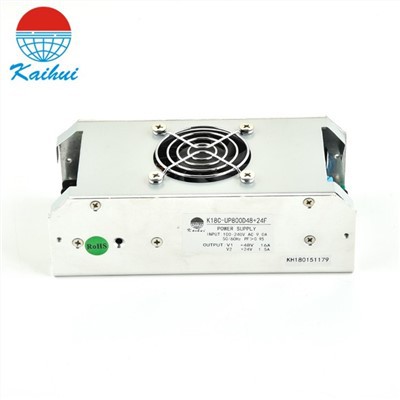
So, there you have it! These are the main output voltage regulation methods used in PFC power supplies. Linear regulation is simple and low – noise but less efficient, while switch – mode regulation is highly efficient but has some EMI and ripple issues. And feedback control and adaptive regulation play important roles in keeping the output voltage stable.
Enclosed Switching Power Supply If you’re in the market for a PFC power supply, understanding these regulation methods can help you choose the right one for your application. Whether you need a low – noise power supply for audio equipment or a highly efficient one for a computer server, I’ve got you covered. Reach out to me if you’re interested in discussing a potential purchase or need more info about our PFC power supplies. I’m always happy to help!
References
- Brown, Walter. "Power Supply Design Handbook." McGraw – Hill, 2015.
- Erickson, Robert W., and Dragan Maksimović. "Fundamentals of Power Electronics." Springer, 2017.
Guangzhou Kaihui Electronics Co., Ltd.
Guangzhou Kaihui Electronics Co., Ltd. is one of the most professional pfc power supply manufacturers and suppliers in China, specialized in providing the best customized service. We warmly welcome you to buy high quality pfc power supply made in China here from our factory.
Address: 2F BLDG8, Standard Ind.Park, Dongchong Town, Nansha District 511453, Guangzhou, Guangdong, China
E-mail: amy@gzkaihui.com
WebSite: https://www.kaihuipowersupply.com/
